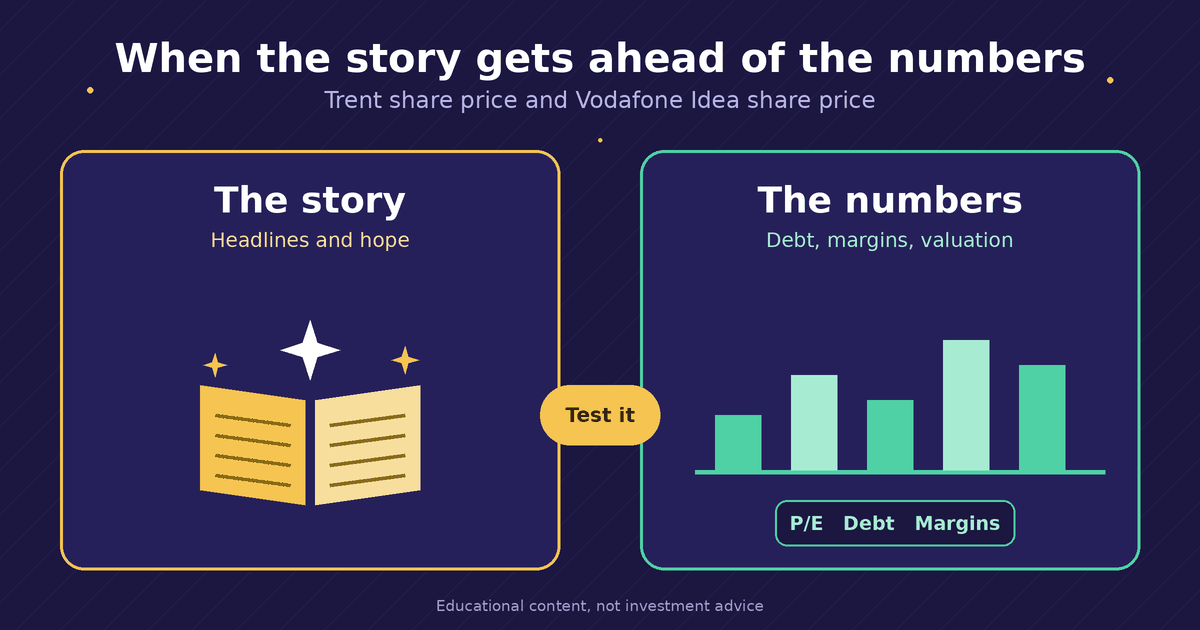
Every stock comes with a story. A retailer that keeps opening stores. A telecom giant that might finally turn the corner. These stories are easy to remember and easy to repeat, which is exactly why they move prices.
The trouble is that a story and a set of numbers are not the same thing. Sometimes they agree. Sometimes the story runs far ahead of the facts. If you follow the Trent share price or the Vodafone Idea share price, learning to separate the two is one of the most useful skills you can build.
The Trent story
Trent, a Tata Group company, runs Westside and Zudio, along with a grocery and daily needs business. The story investors tell about it goes something like this: a well-run retailer, backed by a trusted group, expanding quickly into new towns with a value fashion format that customers love.
That story is attractive, and parts of it are backed by what the company reports, such as store additions and sales growth. But a story like this has a built-in weakness. When everyone believes in it, the price rises to reflect it. Eventually the share price assumes that growth will continue for years, and the numbers have to keep delivering just to justify what investors already paid.
So the useful question about Trent is not “Is it a good company?” It is “How much of the good news is already in the price?”
The Vodafone Idea story
Vodafone Idea has a very different narrative. It is the debt-heavy telecom operator that might recover if the government, lenders, and customers all line up in its favour. Over the past couple of years, the story has had some real chapters. The government converted part of the company’s spectrum dues into equity, taking its stake to about 49 percent, according to news reports. A relief package was also reported to have frozen AGR dues of ₹87,695 crore and moved their repayment to a window between FY32 and FY41.
Each of these events sparked hope, and prices have often jumped on such headlines. But hope is not the same as recovery. The company still has to fund its network, hold on to customers, earn enough from each user, and manage a large debt load. A positive headline helps, yet it does not fix those underlying pressures on its own.
How stories move prices
Stories matter because markets look forward. A share price is a bet on the future, and stories are how people imagine that future. Three patterns show up again and again.
Headlines create sharp moves. A court order, a policy announcement, or a results release can push a price up or down within minutes, often before anyone has digested the details.
Repetition builds confidence. The more often a story is told, the more true it feels. A stock that everyone is talking about can attract buyers simply because it is popular.
Reversals hurt. When reality does not match the story, prices can fall faster than they rose, because many investors were holding for the same reason.
None of this means stories are useless. It means you should treat them as a starting point for questions, not as proof.
Turning a story into questions you can test
Here is a simple method. Take the story, break it into claims, and check each one against data.
For Trent, the claims might be:
- “It keeps growing.” Check revenue growth and store additions across several quarters.
- “Customers keep coming back.” Look at same-store sales, which show whether existing stores are selling more.
- “It makes money while growing.” Check operating margins, not just sales.
- “It is worth the price.” Compare the price-to-earnings ratio with its history and with other retailers.
For Vodafone Idea, the claims might be:
- “Government support has fixed the problem.” Check how much debt remains, what the interest burden looks like, and when payments fall due.
- “It will hold on to customers.” Look at subscriber numbers and average revenue per user over time.
- “It can fund its plans.” Read what the company says about raising money, and whether it has actually been raised.
- “It is generating cash.” Check cash flow, not just reported profit or loss.
If a claim holds up, good. If it does not, you have learned something valuable before putting money on the line.
Why a low price tempts people
Vodafone Idea’s share price is a small number compared with many large companies, and that makes it feel accessible. A low price per share can feel like a bargain, and it is easy to imagine large percentage gains from a small base.
But the price per share tells you nothing about value. It reflects how many shares exist and what the market currently pays. A company with a small share price and a very large number of shares can still be expensive or risky. What matters is what the whole company is worth compared with what it earns and owes.
The same logic applies in reverse to Trent. A higher price per share does not mean the company is overvalued. Valuation ratios do that job far better.
A quick comparison
| Trent | Vodafone Idea | |
|---|---|---|
| The story | Steady retail growth | Recovery after heavy debt |
| What supports it | Expansion and sales trends | Government support and policy relief |
| What the story can hide | Very high expectations in the price | Ongoing funding and competitive pressure |
| Best test | Growth, margins, valuation | Debt, cash flow, subscribers |
A habit worth building
Before you buy any stock, write down in one or two sentences why you want to own it. Then write down what would prove you wrong. For Trent, that might be slowing same-store sales or shrinking margins. For Vodafone Idea, it might be a failure to raise funds or continued customer losses.
Having that note in front of you makes it easier to stay calm when the price swings and the headlines get loud. It also keeps you from holding on out of habit when the facts have changed.
Final thoughts
The Trent share price and the Vodafone Idea share price both carry strong stories, and both stories have real facts behind them. The skill is in knowing where the facts end and the optimism begins. Enjoy the narrative, but always test it against the numbers, and size your investment to match how confident those numbers make you.
Read the latest results, check the debt and valuation, and invest only in line with your own goals and your tolerance for risk.
Disclaimer: This article is for educational purposes only and is not investment advice. Investments in the securities market are subject to market risks. Please read all related documents carefully and consult a SEBI-registered advisor before investing.